


(Not) According to Plan
Residents of an 18-unit condominium development in Scituate thought they were getting problem-free retirement places to live when they moved in three years ago. But disputes between the developers, unfinished landscaping and driveways, drainage issues and three units they say were not constructed according to plans approved by the town have dominated much of their tenure there. Jim Hummel, during a three month-investigation, discovered that finding someone in government to take responsibility has been elusive.
SCITUATE - They moved here three years ago from Lincoln, Coventry and North Providence, to what prospective owners thought would be their dream retirement condos: single-floor units surrounded by woods and quiet, a mile from the Scituate Reservoir.
But disputes between the developers, unfinished landscaping and driveways, drainage issues and three units they say do not match theirs - and were not constructed according to plans approved by the town - have dominated much of their tenure at McIntosh Estates on Chopmist Hill Road.
And finding someone in government to take responsibility for the shortcomings throughout their 7-acre development has been elusive, as Scituate has no full-time town administrator or manager. And a state board that’s supposed to regulate contractors told them to look elsewhere for relief.
A three-month investigation by The Hummel Report found a revolving door of building officials who were tasked with approving various aspects of the project. Owners say the developer, John Pereira, has not lived up to the promises he made when they bought their condos in late 2021 into mid-2022. Most cost $400,000 and up.
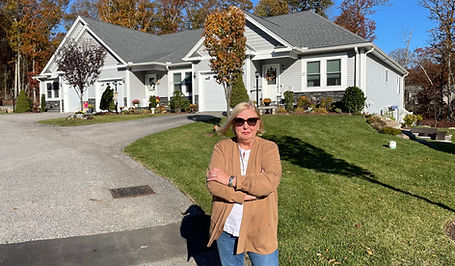
“I’m extremely frustrated with the town and the state, it’s like a hot potato,” said Michele Diamond, president of the homeowners association, who moved with her husband into their 1,450-square-foot condo in the summer of 2022. “Nobody wants to take any ownership and say it’s my role to see that he completes this job and does it according to the approved plan.
“I’m at a loss and can’t see any assistance from the town in any resolution that delivers the completed, aesthetically-pleasing community we all envisioned and paid for.”
The residents say they are a minimal burden on town services: because it’s a private road, they don’t receive trash pickup or have their road plowed; and they aren’t sending children to the school system. But they do expect town officials to do their jobs.
“We feel as though the town has pretty much let us down,” said Joe Carbone, who moved here with his wife after living in North Providence for 50 years. He said his tax bill is around $6000. “We pay taxes, they’re not cheap here.”
McIntosh Estates dates back almost a decade – first dubbed Chopmist Hill Estates - when developer John Mahoney bought the property on Route 102. Mahoney had begun the permitting and master plan approval process right before he was elected to the Scituate Town Council in November 2016. He put the project on hold until after he left office, in early 2019. Resistance from a neighbor that included a lawsuit had also delayed construction. Mahoney said that right before he cleared the land in preparation for putting foundations in, one of the neighbors secretly moved a surveyor’s stake. That resulted in damage to wetlands and a fine from the Department of Environmental management when the resident called DEM to complain. He reached a settlement with the agency for about $20,000.
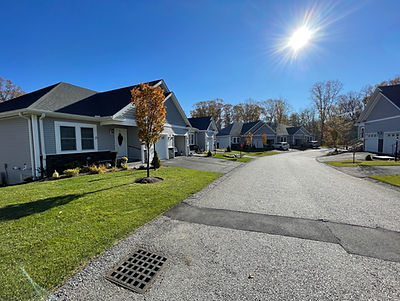
A proposal approved by the town’s Planning Board called for six buildings, with three units each: the ones in the middle were designed to be “affordable.” The one-level units were all marketed with open floor plans, granite counters, hardwood floors, 2 en-suite bedrooms, and unfinished basements.
Mahoney joined forces with John Pereira, who provided the financing while Mahoney constructed the first five buildings. The agreement called for them to split the proceeds. Mahoney, who had transferred ownership of the property to Pereira early in the project, constructed the first five buildings, a total of 15 units. But their relationship devolved, ending in litigation over money and bad blood between the two men. A lawsuit is still pending.
Bill Turgeon had a front row seat from his deck while the second foundation was being laid and would later tell the Planning Board at a meeting in October that Building A was still less than the required 30 feet from his property. He called the proposed building a monstrosity.
“I didn’t move to Scituate to retire and hand my neighbor a coffee,” he told the board. “When I put my money down in good faith, I thought the plan would be followed.”
The neighbors also said the building was constructed several feet higher than approved, had a different design, and six steps leading to the front door, rather than the one or two each of them had.
“Whether (Pereira) made a mistake or whatever he did wrong, that’s unfortunate,” Carbone told the board. “We’re the ones living there. We’re the ones that have been looking at this debacle of a mess for the past two years.”
Pereira asked the Planning Board to allow him to modify the plans to accommodate shorter setbacks and the higher elevation, because digging a deeper foundation to meet height requirements would require the additional cost of removing rock and ledge.
Pereira began construction of the sixth – and final – building, known as A, in 2023. Almost from the beginning the neighbors saw problems. At one point, the town ordered Pereira to rip out a foundation he had put in because it did not meet the plans approved by the town.


Pereira told them repeatedly during the meeting he’d made a mistake. According to minutes from the meeting, one board member told Pereira that he hadn’t made a mistake, he’d made a decision to build in the wrong place. “You’re asking us to change our original approval, to fix your problem,” he said.
After extensive questions and testimony from the public, the board unanimously rejected his request for a modification. But neighbors say he built a non-approved building anyway.
Pereira denies that. In an interview last week with The Hummel Report he insisted that Building A was constructed “exactly” like the other five. But the town has no paperwork – and Pereira could not produce documents - to square what he built with the plans approved by the town.


Diamond filed multiple complaints with the Rhode Island Contractors Registration and Licensing Board. The board, in a letter dated Aug. 13, wrote: “There is insufficient cause to support the initiation of disciplinary action at this time,” adding that the more “appropriate” recourse would be to hire a lawyer.
“Their investigation is picking up the phone and calling Pereira, he comes up with some lame excuse, and that’s the end of the complaint,” Diamond told The Hummel Report.
Through a public records request, The Hummel Report obtained building permits and approvals from the town dating back several years. They show multiple inspectors visiting the property, including two from the state when Scituate was between building officials. Matthew Lambert approved the foundation in August 2024. Thomas Varatta, now the building official in Tiverton, in an interview, said Building A was largely done when he visited in late 2024 to inspect framing. Varatta said he made Pereira redo some work, but he eventually passed.
Mike DiOrio, who arrived from Smithfield as the Scituate building official at the beginning of this year, told The Hummel Report: “My involvement in McIntosh is about .1 percent,” adding that previous inspectors had signed off on the layout and design of the building – not double checking to see that what Pereira was building squared up with the plans approved by the town.
“The only thing I’m looking at it is the basic life safety features in the house,” DiOrio recalled of his visits to the site. “I would never think to go back and be like: could there have been an issue with the Planning Board? That isn’t something that would even be on my radar because all of the inspections were signed off by (a previous inspector).”
As a result, DiOrio issued a temporary certificate of occupancy (which expired in May), and three owners bought the remaining units. They still don’t have final certificates of occupancy and it’s unclear how the buyers secured mortgages or insurance for their property.
DiOrio, who worked as a building official in Providence for eight years, said he had a case where a building looked completely different than what was approved. Work on the building has been shut down for five years.
“That’s supposed to be part of the rough framing inspection,” he said. “At that point, that’s when you have to tell (the developer) to make the change. If you don’t make it at that point, then it’s insulated and dry walled.”
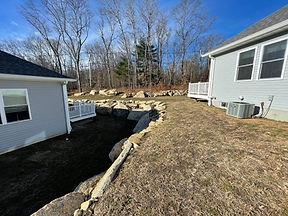
DiOrio has been working with Pereira on another aspect of the project: finishing landscaping and drainage work and putting down a final layer of asphalt on the driveways of each unit. Diamond showed us her garage and the two-inch lip she has to drive over to get in and out because there is only one layer of pavement. It’s been that way since she moved in three and half years ago.
Mahoney, who has dealt with many building officials over the past several decades, told the Hummel Report: “Any building official, whether they’re on loan, a state official, they all have an obligation to pay attention to what’s going on out there. And if any one of them at any time said they didn’t know what was going on then they’re not being truthful.”
Pereira and his attorney, in a conference call earlier this month with The Hummel Report, noted that state law allows him five years from the start of the project to get everything done on the punch list. That deadline was extended to 2027 because he appealed a notice of violation from the town. But with the cold weather and asphalt plants closing for the winter, he won’t be able to get the final paving done until next spring.
So why not sooner? Pereira said he needed to finish Building A before he could pave the driveway in other parts of the development. “It wasn’t where I could do half of it, then half would be disturbed by heavy equipment, trucks, concrete trucks. It sounds like a good idea, but it really wouldn’t work in this situation.”


Joseph Casali, who is contracted by Scituate to be its town engineer, filed a report with the town in April after inspecting McIntosh, outlining nine landscaping and design items that needed to be completed.
He returned last month and reported that many had been done, but the paving is still on the punch list.
In an interview with The Hummel Report, Casali said the more significant issue is the design/construction of Building A. “I found out that the foundation was incorrectly placed. They may have put it too close to another foundation and violated the fire separations distance.” Casali said. “We went out there; the plans don’t have a slope on the driveway, but the driveway slope is clearly greater than what the plans show it to be if you were to do some quick math.”
The neighbors describe it as a ski slope.
Despite that, Pereira is adamant that the building he constructed matches the other five. “The building is exactly like the others,” he said. “Some have one step, two, three, five. That’s just from the topography. There’s nothing you can do about that, depending on the surrounding ground. But the building is exactly the same.”
Carbone said that’s just not true. “We watched it go up. By simply looking at it, it was wrong” adding that Pereira didn’t dig the foundation down far enough.
Turgeon added that some prospective buyers backed out because of the number of steps leading to the units. “They were supposed to look like mine, not have all the steps out front. They look kind of goofy.”
The Hummel Report asked the town – and Pereira – for so-called “as-built” documents: a blueprint-like drawing completed by a developer’s engineer to show that what is built matches what the Planning Board approved.
The town initially provided us with a drawing by Pereira’s engineer, Thomas Principe, dated Jan. 22, 2025 that contained no elevations or contours, or setback distances between buildings. Pereira’s lawyer provided us with an as-built dated Aug. 2023 – two months before he asked the Planning Board for relief – that shows Building A four feet higher than approved, and 20 feet 7 inches between the structure and Turgeon’s building; the town required a 30-foot separation.
Neither Pereira – nor the town - has been able to produce a final as-built showing what he built matches the approved plans.
Pereira’s lawyer later provided us the same Jan. 22 document labelled “Signed Stamped Condo Plan January 2025” that is revised and shows a 30-foot-8-inch inch separation between Building A and Turgeon’s condo – but it contains no elevations for the building, or slope of the driveway. The document has not been filed with the town of Scituate.

Pereira’s attorney also provided The Hummel Report with letters from two different surveyors regarding the foundation of Building A. An East Greenwich company in April stated that the foundation was “in the proper location as it was proposed.”
In August, a Wakefield engineering company wrote that the foundation was constructed “in substantial compliance” with the approved plans.


The Hummel Report tried contacting Principe – who is no longer working for Pereira - to verify that the January as-built document was prepared by his office. He did not answer three emails, three calls to his office and three messages left on his cell phone. Pereira no longer employs Principe as his engineer.
Casali said letters from surveyors about the foundation might not be enough. “Now what he’s got to do, even though the building official may have missed it, his design professionals have to sign off on it,” Casali said “He’s had a whole team of them.”

Mahoney, who has heard from several of the neighbors about the issues at McIntosh, put the blame largely on the town. He told The Hummel Report: “The turning of the head, the not paying attention to detail and allowing the sliding scale of enforcement to take place, was so blatant. And it was rubbed in the faces of the people that bought into that development. They have called numerous times, flurries of phone calls came in from concerned residents in that neighborhood, saying hey this building doesn’t look like the others.”
What would the neighbors like to see? “(Pereira’s) got to come here and finish this job. This is just neglect, I don’t know how he can get away with it,” Diamond said.
Carbone added: “The town, I would hope, should be able to force Pereira, give him some type of push, or monetary fine, if he doesn’t complete this within a certain time frame.”
The Hummel Report is a 501(c)(3) nonprofit organization that relies, in part, on donations. For more information, go to HummelReport.org. Reach Jim at Jim@HummelReport.org.