


Out In The Cold
The number of people living in tent encampments in Rhode Island has increased dramatically over the past five years, as soaring apartment rental prices are driving some out on the street. This week, Jim Hummel kicks off a series of stories looking at who is living outside, and why – and some of the people who are trying to help them.
It’s 23 degrees on a Tuesday morning in January and John Chiellini trudges through ankle-high snow at a tent encampment in Pawtucket.
“John from Better Lives – anybody there?” he yells repeatedly, going from tent to tent to see how everyone is doing. Dozens of people call this stretch of land on the banks of the Seekonk River home. Chiellini, an outreach worker and case manager for the nonprofit Better Lives Rhode Island, is here to help.
Many know him – and trust him – because Chiellini has been in their shoes: a drug addict who lived on the streets after spending nearly 15 years in federal prison before turning his life around. He knows the effects of childhood trauma and has seen the rampant health problems people on the street are battling.
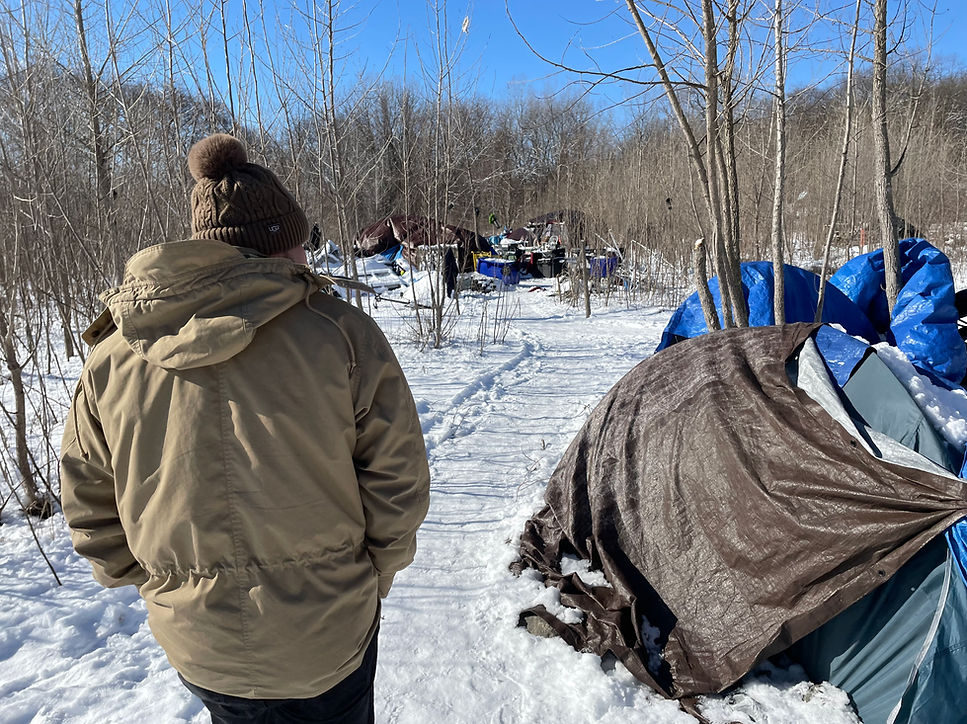
Chiellini offers food and a blanket to one person and asks others if they have a case manager. Further into the woods he runs into someone he knew from prison.
“It automatically builds trust, said Chiellini, 43, whose mother introduced him to drugs when he was 12. “They call me one of them. They know I was homeless. I was homeless with half the people I saw today, so they know my story. I talk differently than most case managers; I’m direct with them, I don’t lie to them.”
The numbers tell the story about how those without homes in Rhode Island has grown: In 2019, an annual census taken in January found 1,055 experiencing homelessness, with 71 classified as “unsheltered.” In 2025 2,373 experienced homelessness and there were 617 people unsheltered – although some believe the unsheltered number may be high.
Chiellini said it was a case worker from Better Lives Rhode Island, a nonprofit in downtown Providence, who helped turn his life around. He got clean, enrolled in a program at Rhode Island College and is now a Certified Community Health Worker. And he has a roof over his head.
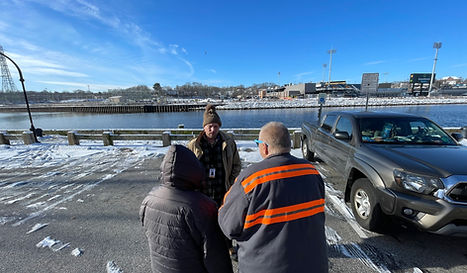
First stop on this chilly morning is a parking lot on the water’s edge where a man named John, and his wife Claudette, have been living in their two vehicles – along with three Boston Terrier dogs – for two years.
Their story is typical of many in an exploding real estate market that has left thousands literally out in the cold. John, who worked as a long-haul trucker, had been renting an apartment in Pawtucket for more than three decades. The landlord died and the new owners kicked him out. He’s been on a long waiting list for housing since then that has left him frustrated and resigned.
Chiellini asks those in tents who respond to his greeting if have case managers. Many say they do – with either Crossroads or House of Hope, two of the state’s larger agencies – but haven’t seen them for more than six months. It’s frustrating for Chiellini because he can’t help them if they’re assigned to someone, even if they’re not getting any help.
After several hours in Pawtucket, he heads to another encampment in the north end of Providence, where he is greeted enthusiastically by everyone he finds in their tents. One woman has constructed what looks like a wooden shed surrounding by a fence. Many say they have been harassed by The Providence Police.
Sometimes he speaks with them through the tent flap, other times they invite him in to sit and catch up – some have heaters, but many are cold. Everyone we meet on this day lives in constant fear of having the encampment cleared, despite the 2012 Rhode Island Homeless Bill of Rights is supposed to protect their private property.
One man named Mike, who is crammed into a small tent with three other people, follows Chiellini down to his car, where he pulls food and a heavy blanket out of the trunk, and promises to follow up with him in a few days.
“When I go to an encampment and ask if they have a case manager and they say they haven’t seen them for nine months, it makes me crazy inside. That’s what I went through at Crossroads,” Chiellini says, recalling when he got out of prison in 2020. He begged for a case manager for six months without success.
Chiellini wishes the state would keep better track of how the money it allocates to nonprofit agencies for homeless services is being spent. “If I could change anything, I wish (the state) would manage the money better and see what companies did what and base the grants on that.”
Janice Luongo publishes a newspaper for homeless people called “Street Sights.” Luongo, like Chiellini, has lived experience, growing up in a dysfunctional household on Federal Hill.
For several years she was homeless and taking drugs until the Sisters of Mercy took her in. It was different in 1970s, she said: Luongo never lived in a tent, instead sleeping in a car or someone’s basement.
Luongo also turned her life around and has lived on Smith Hill for the past 50 years. She took over editing Street Sights three years ago, after being involved for a couple of years before that.

Before running into funding challenges, she used to print 1000 copies, which were distributed by outreach workers throughout the state. In addition to stories of people experiencing homelessness and those trying to help them, every issue carries a listing of available resources. She has recently moved to a digital-only publication.
“We’re not going to get anywhere unless the government shifts from managing the crisis to solving its root causes, Luongo said. “To me, the answer to that is: housing first.”
No one would disagree with that approach, but the state of Rhode Island has lagged for decades producing new housing, let alone affordable units for those on the street. Luongo said it’s easy for lawmakers to look the other way because those on the street have no one to lobby for them. “You’re a senator, you’re a rep, what are you doing?” she asked.
Luongo added: “I believe this is solvable, but we don’t have the right people around the table. We don’t have people who care about and want to make this system work. You have a governor who last summer said he didn’t believe the numbers the (Rhode Island Coalition to End Homelessness) gave him,” about the number of people without housing.
Luongo said there are many underlying causes that lead to someone being out of the street: substance abuse, mental health or maybe childhood trauma. And even when pop-up shelters open, as they did during the bitterly cold periods in January and February, there are some who still won’t go inside.

Many chose to ride it out in their tents because they either didn’t want to – or couldn’t – be around others in a congregate setting; others were feeding a drug addiction or were concerned they’d be robbed if they left.
“They lump everything together,” she said. “You have to separate them out because the needs are different for each individually. It’s not just a house. You might be able to find housing, but you wouldn’t know what to do because you don’t have the skills to get their life back together.”
Those living in tents throughout Rhode Island faced the added challenge of a harsh winter, with an extended cold stretch and two heavy snowfalls, including last month’s record-breaking blizzard.
Bernie Beaudreau has been visiting encampments since last fall. Beaudreau, 71, is retired but ran the Rhode Island Community Food Bank from 1994-2006.
He had a childhood friend who became homeless when they were 20 and spent most of his life living outside. He was an alcoholic and died three years ago. And that weighed on him. “I was always conflicted: how do I help him?” Beaudreau said.
He got involved in December 2024, joining the Rhode Island Homeless Advocacy Project, a wide-ranging coalition of people interested in the issues surrounding the unhoused. “There are a lot of stereotypes,” he said. “Not everyone is a mentally ill drug addict.”

He began chronicling for Street Sights his visits to Harrington Hall, a shelter for men in the Howard Complex in Cranston. One problem he immediately noticed: everyone had to carry their belongings with them, often in a garbage bag, as the shelter required everyone to leave by 7 a.m. on most days.
As the weather began getting colder last fall, Beaudreau began visiting encampments in Pawtucket and East Providence and learned that many were using propane heaters but often didn’t have enough money to keep them going. Beaudreau and a friend began purchasing it for them. He pays for about a dozen people a week, at $20 a tank, for refills. Word got out what he was doing, and others have donated to the cause.
On a relatively mild day last week, The Hummel Report followed Beaudreau as he slogged his way through knee-deep snow far into the woods with two tanks in hand. The blizzard had crushed several tents, forcing people to re-pitch, or in some cases get new tents.
Beaudreau was a welcome sight by the three people he visited this afternoon.
“For a little while I’ll supply who I can, in the time and with the finances I have available,” Beaudreau told The Hummel Report. “It’s given me a chance to see the diversity and kinds of situations and stories people have that are homeless and encamped – as opposed to being on the street or homeless in one of the sponsored shelters.”
One man we visited had been living in Fall River but broke up with his partner and could not afford any of the apartments available. So, he’s in a tent.
“More often I’ve heard they can’t afford the rent,” Beaudreau said, especially since eviction protection for renters disappeared after COVID. He added that 240 people also lost vouchers for Section subsidized housing resulting from federal cuts.
“It’s a much more diverse group,” he said. “You have a lot of people who have careers and experience, they’re the working poor. Now, in what would be the cheapest parts of town the prices have inflated.”
Beaudreau was incredulous when the city of East Providence, on short notice, cleared an encampment days before a heavy snowstorm in January, citing unsafe conditions and the use of propane tanks. Beaudreau said someone saw a tent from a walking path and lodged a complaint with the city, triggering the eviction with heavy equipment in the woods.
The city responded that it had opened temporary warming shelters, but Beaudreau said, what would happen to the tent-dwellers after the storm passed? He added that he understands the concern about propane heaters and the potential safety risks, but the alternative is freezing to death in single-digit temperatures.
Beaudreau, who has become a trusted visitor in the encampments, agrees with Luongo that the issue is multi-layered. “If you sift through 100 people, in shelters or the encampments, there are 10 different categories that would need a treatment program.”
He said they need counseling, encouragement and coaching. “A lot of the younger people could have an employable future, but they have barriers to get over. One of them is not having a place to take a shower, dress up and be ready for work. People in tents may be the most resourceful: how to heat themselves, panhandle if they have to, or get a job at a store.”

There are some success stories. Quiana Dussault had been living in a tent for six years, not far from where she grew up in Pawtucket. Chiellini became her case worker six months ago and worked tirelessly to gather documents she needed to apply for housing – something her former caseworker did not do.
Dussault’s story mirrors many we heard over the past two months: She lost her partner, couldn’t keep up with rent, began living in a tent, lost her job and her health deteriorated. And she began abusing drugs. “It just kind of barrel rolled from there,” she told The Hummel Report.
We visited her that day in January, where half a dozen people were crammed into her tent in Pawtucket. She rode out the bitter temperatures this winter. “It was horrible, I had three or four blankets on top of me. It’s very hard, but you just adapt.”
Several years ago, she woke up in the middle of the night with the tent only inches away from her face. It had collapsed from a heavy snowfall. Dussault has anxiety issues and was hesitant to leave the tent because she does not do well around other people – and was worried about returning and finding everything gone.
Last month she learned she had gotten into one of the renovated apartments on the upper levels of Crossroads, moving in a short time later. “I couldn’t wait to get out of the woods so bad.”
She’s also getting used to having the space of a one-bedroom apartment. “I feel like it’s too big,” she said, laughing.
Chiellini acknowledges that many case workers have burnout; he juggles up to 40 clients at a time. But, he said, getting Dussault into housing was a victory that energized him. “I love it, I can’t get enough of it. I work more hours than I’m supposed to. It doesn’t feel like a job for me.”
The Hummel Report is a 501(c)(3) nonprofit organization that relies, in part, on donations. For more information, go to HummelReport.org. Reach Jim at Jim@HummelReport.org.