


Competing Interests?
Eight years after planners first envisioned bringing permanent food service and public restrooms to the 195 District Park, a 3,500-square-foot pavilion opens this month – amid criticism from some surrounding restaurants that taxpayers are funding an operation that is competing with dozens of private businesses. Jim Hummel follows up on his investigation from 2022 and finds that the final price tag is significantly higher than originally estimated.
PROVIDENCE – Eight years after planners first envisioned bringing permanent food service and public restrooms to the 195 District Park, a 3,500-square-foot pavilion opens this month – amid criticism from some surrounding restaurants that taxpayers are funding an operation that is competing with dozens of private businesses.
The pavilion project, first estimated to cost $4 million, jumped to $6 million by the time construction crews broke ground in 2024. The final price tag is $6.4 million, plus another half a million dollars for new electrical service, drainage and Wi-Fi in the seven-acre 195 District Park.
That’s a total cost of the park project - $6.9 million – is a 72.5% increase over the original estimated cost. Taxpayers are also on the hook for interest payments on the $4 million bond. The pavilion has public restrooms, office space, and a 2,200-square-foot restaurant with year-round service.
“If you look at the last couple of years, any construction anywhere, costs are through the roof,” said Marc Crisafulli, who took over as chairman of the I-195 District Commission in early 2023. “It’s a real problem,” he added, noting that original cost projections were made in 2019, long before the aftermath of a pandemic that boosted construction prices nationwide.
The I-195 District Commission is receiving another $3.6 million, spread over three years, from the Rhode Island Capital Improvement Fund to bridge the funding gap. That will pay for additional architectural and engineering costs, the installation of more security cameras, replacement of broken trash cans and a $100,00 cushion for other unexpected expenses. That boosts the total price tag to $7.6 million, nearly double original estimates.
“(The I-195 Commission) should have stayed in its lane,” said Robert Burke, owner of the Pot Au Feu in downtown Providence since 1986, and a leading critic of the pavilion project. “Its job is to find big companies, take over the parcels, provide lots of construction jobs and lots of permanent jobs. That’s what their mission is. They shouldn’t be building any business with state money that directly competes with existing businesses. It’s 100% state capitalism.”
The Hummel Report first detailed plans for the pavilion in a Sunday Journal article in July 2022.


Isle Brewers Guild won the concession contract for the pavilion and has crews working to open in time for World Cup activities in Providence next week. Co-owner Jeremy Duffy is calling the restaurant Guild PVD, a play on similar operations in Pawtucket and Warren.
“I was very jealous of beer gardens being produced in Boston,” Duffy told The Hummel Report. “Every great city has a beer garden and Providence didn’t have one,” he said, adding that is how the Guild began operating out of temporary trailers on the park grounds in the aftermath of the pandemic. He declined to say how much he has spent to build out the pavilion restaurant, which encompasses 2,200 square feet of the 3,500 square foot building; he would only say that it is a significant investment.
Duffy said Guild PVD plans to operate seven days a week and has reached an agreement with Seven Stars Bakery to provide coffee and baked goods in the morning, served by Guild employees. Seven Stars will sell its product to Guild at a wholesale price, with a markup for the retail operation at the pavilion. The state gets a percentage of all sales.
The Guild will provide lunch and dinner. The initial plan is to open from 7:30 a.m. until 8 p.m. Monday through Thursday, close at 9 p.m. or 10 p.m. Friday and Saturday, then 6 p.m. on Sunday. The operation is likely to scale back during the winter months.

“We don’t know yet how it will look in the winter,” Duffy said. “We have great partners in District Park. Our goal is to maximize revenue. Not only for the Guild, but my goal is to generate so much money that they get above market price for that real estate.
The lease, awarded in July 2023, calls for Guild to pay $500 a month rent, plus 8% of beer sales and 4% of food sales to the I-195 District Commission, which estimates to be roughly $7,000 a month, or $84,000 a year. It’s a five-year escalation lease with an option to renew for another five. In the ninth and 10th years, The Guild would pay $1,000 per month rent, plus 9% of beer and 4.5% of food sales.
How did they arrive at those figures? Skuncik and Duffy said they don’t remember specifics, only that lawyer for each side hammered out the details.
“We’re very comfortable with the deal that we cut,” Crisafulli said. “We think it’s important. There’s a lot more at stake here than just having a little building. This is a central piece of what we’re trying to build in the park.”

The Hummel Report contacted several commercial real estate brokers who said the rental agreement is “a great deal” – because a private developer never would have spent more $6.4 million on a building that size. They would need to charge much more for the lease to pay off the construction costs picked up by taxpayers. The I-195 District Commission sees it as a public investment in a high-visibility location.
John Elkhay owns five restaurants in downtown Providence with 200 employees and echoed the analysis of the commercial real estate brokers. “When you’re dealing with people who have never had to make a budget, and it’s easy to print more money by raising taxes, there’s no fiduciary responsibility,” Elkhay said. “When the state is competing against us head-to-head, it’s not a great situation because they have nothing to lose; only we have something to lose.”
With a price tag of $6.4 million, the pavilion cost taxpayers $1,828 per square foot to build. The recently opened 212,000-square-foot life science building at 150 Richmond Street cost $778 per square foot (and $1,021 per square foot for the pricier state laboratory portion). The building features advanced research and testing space, genome sequencing, infectious disease testing and forensic/environmental monitoring.

Caroline Skuncik, executive director of the I-195 District Commission, said it is not a fair comparison because larger buildings are more cost-effective.
“It’s very hard to compare a small building to a large building on a square foot basis because there are certain costs spread over a 200,00 square foot building, like utility cost, site work costs,” she said.
“For this tiny little building there was a huge amount of site work to get all of that stuff in the middle of the park,” Skuncik added. “It’s spread over 3,500 square feet so obviously you’re going to have a higher per-square-foot cost.”
Burke provided The Hummel Report with a spreadsheet that shows 60 food service businesses within half a mile of the new pavilion. Skuncik told the Hummel Report in 2022 - and reiterated in an interview last month - that a consultant hired by the district said the park should have permanent food service.
Burke responded: “If they have a consultant who says that what this district needed more than anything else in the middle of 60 of the best restaurants in America was another restaurant, then that consultant was utterly incompetent or told by the commission what they wanted to hear.”
Crisafulli rejects Burke’s assertion that the pavilion will compete with area restaurants, noting that nearly two million people visit the park annually.
“We don’t view it that way,” Crisafulli said. “It’s an arm’s length tenant that’s there. So, it’s not like we’re subsidizing them. It’s the essence of free market and competition. They don’t have a monopoly. We support all the restaurants around as well.
“The more people that come here, the more people activity here, the more commercial benefit there’s going to be for everybody. And that’s our mission. At the same time, we’re not going to not have a centerpiece in a critical park that over a million people visit, out of deference to forcing them to go somewhere else,” Crisafulli added.

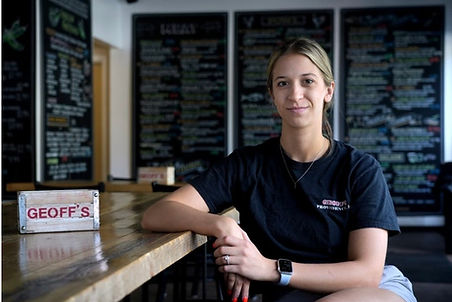
Burke countered: “Many of the other restaurant owners risked their life savings, mortgaged their homes and borrowed from friends to build their business. Now they have to compete against the unlimited resources of the State of Rhode Island - that is so wrong on so many levels. They guy who is going to get a sandwich (from The Guild) might have gone to Geoff’s.”
Julianna Fonseca owns Geoff's Superlative Sandwiches on South Main Street, a block from the pedestrian bridge and pavilion. She told The Hummel Report in 2022: “They’re spending millions of dollars to put in, essentially competition - or to pull away from already what’s going on here. If someone can get something right there, they’re not going to venture out. So that’s what I see happening with this food pavilion, it’s one-stop shopping. They go there; they don’t have to go anywhere else. They don’t even have to look anywhere else.”
The initial funding for the pavilion came from a bond approved by voters in an off-year special election in March 2021. Gov. Gina Raimondo initially planned to fund the project through the state budget, then shifted gears and asked that it be included in a $74 million “beach, clean water and green bond” that passed with 78% of the vote.
Raimondo’s staff offered this written description of the project: “…physical infrastructure at the District’s parks, including an event stage, concessions, expanded utility services, restrooms and trash receptacles, and capital projects in conjunction with adjacent properties.”
There was no mention of a restaurant or food pavilion.
Question No. 2 on the March 2021 special election ballot asked for $4 million for the park infrastructure. “Funds will be used to construct park infrastructure to enhance utilities, support park operations and programming, and enable food and beverage service,” the wording said.
There was no description of year-round, indoor, sit-down dining service, which became part of the early discussion after the bond passed March 2. Many of the restaurant owners we spoke with said they voted for the bond, not knowing it would pay for a restaurant they’d eventually have to compete with.


So how did The Guild get the pavilion contract, something Burke describes as a “sweetheart deal”? Skuncik said the district put out a request for proposals in late 2022 and it was a competitive bid process. Burke notes that it was a 40-day procedure over Thanksgiving and Christmas, with a submission deadline of Dec. 23 – typically restaurant owners’ busiest time of the year. He asserts that The Guild had the inside track because it had been operating the beer garden for several years and a relationship with the I-195 District Commission.
Skuncik said the district held three informational sessions for interested operators, one in person and two virtual, met one-on-one with about 30 potential operators and sent the RPP directly to the Rhode Island Hospitality Association and The Providence Warwick Convention and Visitors Bureau and asked them to share it with their network.
Many of the restaurant owners we spoke with said they had no interest in bidding on the pavilion job. Brian Kingsford, who owns Bacaro on South Water Street, said: “I remember looking at (the RFP); at the time we were building Otra (Restaurant on South Main Street). The last thing I wanted to do was jump in on that. I also felt like it was a done deal.”

Sharon Steele is the longtime president of the Jewelry District Association who attends virtually every meeting of the I-195 District Commission and has watched planning for the pavilion evolve.
“I never wanted the (pavilion) to happen,” she said, adding that using green bond money was misleading for the taxpayers. “You say ‘open space,’ I say build out a park, not build on a park,” she added.
“In the original concept there were going to be seasonal kiosks that would offer three kinds of food. But they were things that could be moved around, that wouldn’t take up this much square footage.” Steele said.
She said the park needed restrooms, but she thought they should be in a corner of the public space.
Steele added that Duffy did everyone a favor by operating the Guild right after the pandemic. “He showed up, he said what he was going to do. He attracted people. There was nothing here,” Steele said. “In retrospect, the building design is attractive. One story and has a turf roof. The public bathrooms are there. But where did they put this thing: right in the direct line of sight of the pedestrian bridge.”

Skuncik said the $6.4 million total for the building came after planners did some “value engineering” – the construction industry euphemism for cutting items out of a project to save money.
“At the end of the day there were things that we felt really important about that we didn’t want to compromise on – like the ability to have a four-season use in the park,” Skuncik said.
In a follow up email to The Hummel Report she listed seven changes made to the original plan that saved a total of nearly $800,000. They include replacing a glass wall with doors ad fixed windows, using a different type of decking for the roof, eliminating some “unnecessary” waterproofing and reducing the number of benches around the building.
But installing a green roof survived the cut. Skuncik said it is covered by sedum, a large hardy, drought-tolerant succulent plant. “(It) requires little maintenance once established. We do have a drip irrigation line for the green roof, which we are using now to establish the plants and can use as necessary in the future,” she wrote.
Skuncik added that it improves stormwater management, saves energy, provides aesthetic benefits and adds a habitat for birds, insects and other wildlife.
The Hummel Report is a 501(c)(3) nonprofit organization that relies, in part, on donations. For more information, go to HummelReport.org. Reach Jim at Jim@HummelReport.org.