


Homeless - With A Plan
From single-digit temperatures and record snowfall last winter, to unrelenting heat that has many people scrambling to find air-conditioned places this summer, Justin Russell has weathered each day as it comes – outside. But unlike many others in tent encampments around the state, Russell has a long-term plan to get off the streets – and is intentionally living in a tent so he can save money and get out of the elements somewhere, some day. Jim Hummel has his story in our continuing series on homelessness.
PAWTUCKET – From single-digit temperatures and record snowfall last winter, to unrelenting heat that has many people scrambling to find air-conditioned places this summer, Justin Russell has weathered each day as it comes – outside.
Russell, 35, has been homeless since 2018. Like some who have no roof over their head, he has had mental health and substance abuse issues. A criminal record for assault has made it virtually impossible to find meaningful employment.
But unlike many others in encampments around the state, Russell has a long-term plan to get off the streets – and is intentionally living in a tent so he can save money and get out of the elements somewhere, some day.
“I don’t want to do this anymore,” Russell said during a series of interviews with The Hummel Report over the past several months. “But if I got to do it for five years to do what I want and live more comfortably I’m going to do it.”
Russell reached out after The Hummel Report did a series of stories on the homelessness issue, published earlier this year in The Providence Journal. The series focused on case workers assigned to the homeless population, a pilot program providing emergency shelter during the coldest days of winter, and how the state has spent $83 million over the past three years on homeless initiatives without much to show for it.
“Where there are major tent cities, it’s all drugs,” he said one day last month, carrying a sleeping bag and backpack outside the Pawtucket Public Library, where he can charge his cell phone and get out of bad weather. “I have to stay away from that.”
He also avoids emergency shelters, which Russell says present problems of their own. “I can get into shelters if I want to. It’s not like I’m going without. I’m not struggling. Most people in shelters are highly mentally ill or on drugs. It’s drama, I don’t want the drama.”
Russell, who regularly smoked crack cocaine and used methamphetamine, quit cold turkey last fall, and stopped using alcohol in December. He said he still smokes marijuana to help settle himself. He keeps track of the days he’s been clean on his phone.
How did Russell get off the hard drugs, when so many others have failed? “You just have to get sick and tired of what it’s doing to you,” he said. “I blew $1000 in one night (on crack) and all my savings. I got stuff I want to do. I want to get a van, I want to travel, I want to get a house. I can’t be messing with this.
“The next morning, I woke up and said ‘I’m not touching it. Done.’ Just like that. I despised being on meth,” he added.

Russell grew up in a toxic family environment in Cumberland, admitting he was a troubled kid who contemplated suicide at age 15. Looking back, he thinks he had ADHD that went undiagnosed. He has a sister and brother, but his dad left when he was 6. He has had a lifelong strained relationship with his mother.
“My household was a mess. I was constantly in trouble,” Russell said. “I was disrespectful to my mom. My teen years, I was lighting fires, skateboarding, smoking weed and playing video games. I didn’t see the red flags as a kid, but as I got older, I realized how toxic it was.”
He was in and out of Butler Hospital, then wound up in a group home until he was 18. After getting out, he went to live with his mother in Maine. But the situation deteriorated rapidly and Russell returned to Rhode Island, eventually moving in with a cousin in Pawtucket. Russell said the cousin was physically abusive to his children and psychologically abusive to him.
Before that, he was living with a girlfriend and was charged with felony domestic violence, which resulted in Russell serving eight months at The Adult Correctional Institution. “The only thing I thought about when I was in prison was how to kill myself when I got out. I did not do well with prison,” he said.
He started living on the streets when he was 27, joining hundreds of others across the state. This year’s Point In Time count, an annual census conducted by the Rhode Island Coalition to End Homelessness, found that in January 2026 there were 2236 unhoused people: 1,820 living in emergency shelters and 416 – like Russell - on the street.
Despite turning his life around, the criminal record for felony assault has dogged Russell and been a significant barrier to getting a job.
Along the way, he moved twice to California, the first time during the pandemic, then again after it had ended. “They have police specifically for the homeless,” he said. “If you’re sleeping on the beach they come by to check on you.”
But he didn’t like the people on the West Coast and ultimately returned to Rhode Island, in part to tie up loose ends on his criminal case.

Seven days a week, Adrienne Marchetti is in the basement kitchen of St. Joseph’s Church on Walcott Street in Pawtucket, preparing hundreds of meals for the homeless population that she’ll hand out on the street, serve at the church and deliver to shelters.
She’s known Justin Russell since before the pandemic and sees him virtually every day, sometimes two or three times a day.
“I always thought he was a good kid,” Marchetti said. “But I knew he was doing the drugs, so that was making it difficult for him to accomplish anything. I would say to him: ‘Don’t you want more than this? Don’t you want better?’”
Marchetti has seen a transformation over the past six months, as Russell has gotten clean – and focused. “He has potential. I think if he’s focused, he’ll be good,” she said.
After working for Amos House for 20 years, Marchetti left to become director of the nonprofit Pawtucket Soup Kitchen in 2009 and now serves 400 meals a day. She’s a one-woman kitchen crew.
“People have to eat and what’s more life sustaining than food? Every day is different,” she said “You see miracles, you see a lot of heartache. You try to always be optimistic.”

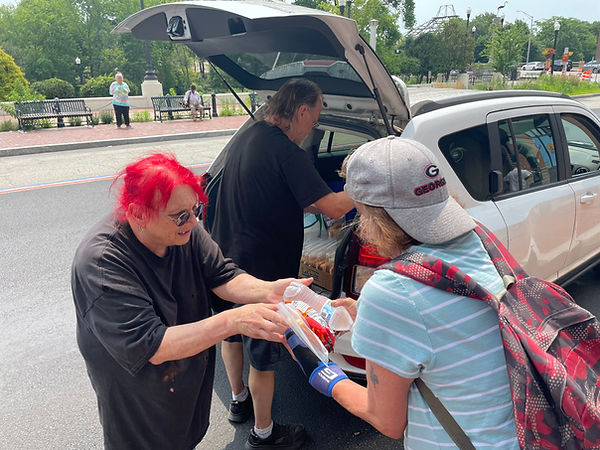
On the morning we visited, Marchetti was making dozens of sandwiches that she would deliver around 11:30 a.m. to a waiting crowd outside the Pawtucket Visitors Center near City Hall. Then she headed over to a Collyer Park, at the corner of Main Street and Mineral Spring Avenue to distribute the rest.
Marchetti knows almost everyone by name, and often personal details. Most are grateful to see her and receive a sandwich, chips and a bottle of water. Later in the day Marchetti will serve a hot, sit-down meal at 4:45 p.m. in the basement of St. Joseph’s Church. Finally, she’ll deliver the rest to area shelters.
Marchetti said she began making lunches during the pandemic because many places closed, so she decided to take food out to the community. She believes it’s important to focus on one or two things and be good at them, and that too many social service agencies are spreading themselves thin.
“You have to do what you’re good at,” she said. “That’s why nothing is getting done because everyone is trying to do everything, and you can’t. I just think we’ve all become too money oriented and not service oriented. It’s about service, it’s about trying to eradicate the problem. It’s not about me keeping my job.”
She added: “We didn’t buy a building and turn it into housing. We’re not housing managers or trying to do job training. Do what you’re good at. We’re the food people.”
Marchetti said it is frustrating that the state has not made more progress on the homeless issue.
“We put too much value on the numbers. How many people did you serve? As an organization I might be serving 100 people. You might be doing the same exact thing – you’re serving 100 people. But it’s not 200 people. It’s the same 100 people. We’re overvaluing how much is out there so you can justify getting extra money.”
And, Marchetti said, there can be a disconnect between the people running agencies and the people they are serving.
“Some people doing this work drive Mercedes and Audis,” she said. “Do you get what we do? We make policies and the people who are in the position to make the policies have no contact with the people. They think they know what they need, but it’s that kind of mother thing. I’m the mother so I know best. But you don’t know best, because you don’t see what we see.”
Marchetti said some of the people she sees spend a good chunk of their monthly Supplemental Security Income checks on drugs and have no direction – only looking for their next hit. “Could we do what we do if we’re lit all the time?” she asks.
Russell, she said, is different, and knew he needed to get off drugs. “He came to the realization all on his own,” she said. “And that’s the key to success: you have to figure it out yourself. There’s a difference between dreams and goals. And that’s discipline.”


Russell said he prefers extreme heat over bitter cold, and that rain and snow are hard to live with- and in. His days involve a lot of walking – up to St. Joseph’s for meals, then back to the public library downtown, and to a new site for a tent that he’s found about half an hour away.
Over the winter he stayed at the old Apex building downtown, where he rode out the blizzard. But over the past few months he’s found a new location to pitch a tent near the Rhode Island/Massachusetts border. He put up a dummy tent he owns and left a bong in it to see if anyone would find - or steal – them.
“There’s a weird freedom about being homeless,” Russell said. “You don’t have anything holding you down. Nothing that’s keeping you from doing anything.”
Russell said he avoids the tent encampments in Pawtucket because drug use is rampant – and he risks having his property stolen. “Where there are major tent cities, it’s all drugs. I have to stay away from that. And I avoid crowds so I can stay away from temptation.”

So far, the new site has been secure, and he is gradually moving his belongings into it. “You’ve got to make time to do things, to get to your resources and take care of yourself,” he said, adding that he tries to eat three meals a day and if he runs short of money will panhandle. He’s living largely on the monthly disability check he receives, but says another goal is to get off government assistance and earn his own way.
Russell says his biggest challenge is fighting boredom. Video games on his phone help, but he wants to work and is thinking of launching his own landscaping business.
“I’ve got a bad criminal record,” he said, even though it happened years ago and he is a different person in 2026. “It’s going to be hard for me to get a job. I’ve got a violent crime, a felony. It’s going to be easier for me to start my own business and do my own work.”
The goal is to get enough money to buy a van and travel around the country to see where he might want to settle down. Then eventually get his own place to live.
He has also launched a blog, where he writes about day-to-day life on the street. “It’s a live journal, you’re reading about my life. What my goals are how my day is going,” Russell said. On the homepage he offers advice to others about living on the street: from carrying a jar of peanut butter and changing your socks daily; to scouting out places to charge your phone and getting a membership to the YMCA, if possible.
Russell says he has been saving money gradually, which has allowed him to boost his credit score and get a credit card.
He writes: “Don’t be a bum. Save money. Raise your credit score. Upgrade! Always stay making positive progression in your position. You can do it!”
The Hummel Report is a 501(c)(3) nonprofit organization that relies, in part, on donations. For more information, go to HummelReport.org. Reach Jim at Jim@HummelReport.org.